·
3 min read
CLP 2026: New Hazard Classes and What They Mean for Your IUCLID Dossiers
The revised CLP Regulation (Classification, Labelling and Packaging) brings the biggest change to EU chemical hazard …
Read More →Have questions? We're here to help.
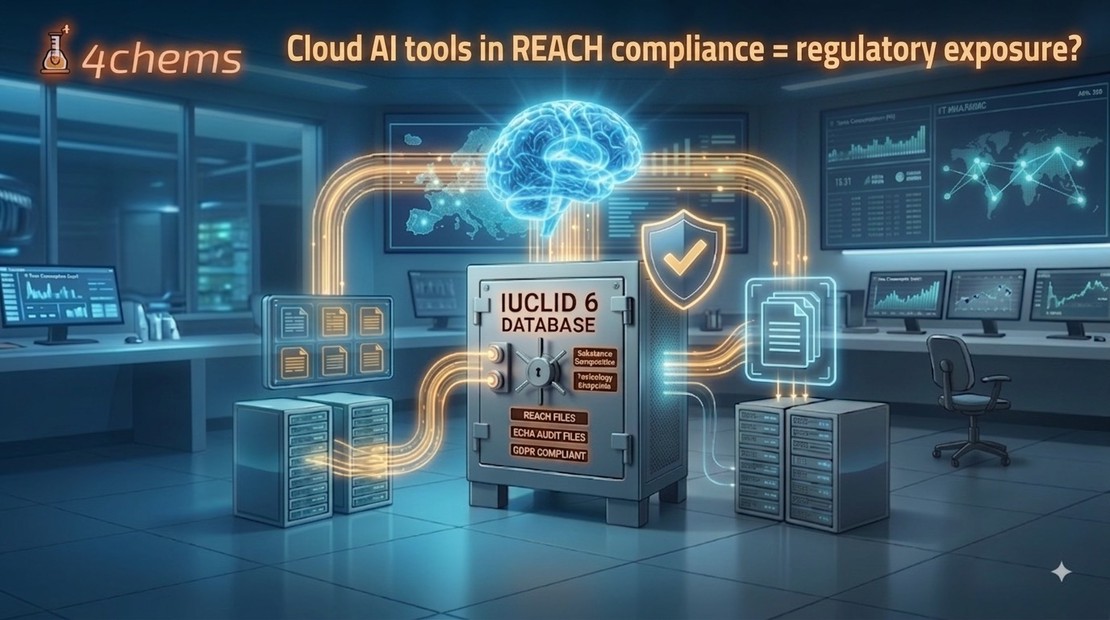
The debate around AI and cloud tools in REACH compliance centres on risk. Here is why the question is not whether to use technology, but how the workflow is designed.
Have questions? We're here to help.
The debate around cloud and AI tools in REACH compliance usually revolves around one word: risk.
The concern is legitimate. AI tools that generate dossier content without expert review create liability. Cloud infrastructures without strict EU data residency create compliance breaches.
But there is a difference between treating technology as a category risk and designing workflows where the exposure does not exist in the first place.
Regulatory expertise is highly specialised. Yet too many compliance teams find their days consumed by IT overhead — scaling servers, managing IUCLID version updates, or worrying whether their cloud provider meets EU data residency requirements.
Your toolchain should not be a second full-time job.
A modern compliance workflow only needs two things to be truly effective.
1. AI stays in the pre-expert layer.
We use AI to cut cross-section consistency reviews from four hours to under ten minutes, and to detect gaps against ECHA validation rules. But the output always goes to a human expert — never directly to a submission file. ECHA does not accept “the model suggested it,” and neither do we.
2. Infrastructure must be invisible and bulletproof.
We have been running IUCLID environments since 2022. All data residency, processing, and storage remain strictly within the EU. In four years, not a single system failure has reached a client’s submission workflow.
This combination means one thing: regulatory affairs teams using 4chems spend their time on regulatory affairs.
Not on manual, line-by-line consistency checks. Not on version upgrade planning. Not on diagnosing environments that broke overnight.
The risk in compliance technology is not the technology itself. It is removing the expert from the workflow it was meant to support.
We handle the background. You make the decisions.
Svetlana Galakhova writes about regulatory infrastructure, AI in chemical compliance, and the operational realities of IUCLID environments. Questions about how 4chems handles data residency or AI workflows — get in touch.
The revised CLP Regulation (Classification, Labelling and Packaging) brings the biggest change to EU chemical hazard …
Read More →
Running IUCLID on your own server made sense when you started. But on-premise installations quietly accumulate cost: …
Read More →
The question we get most often from compliance directors at consulting firms: how do you make sure my client’s …
Read More →The tools and solutions behind these insights — managed IUCLID, CHESAR and QSAR Toolbox in the EU cloud.