·
6 min read
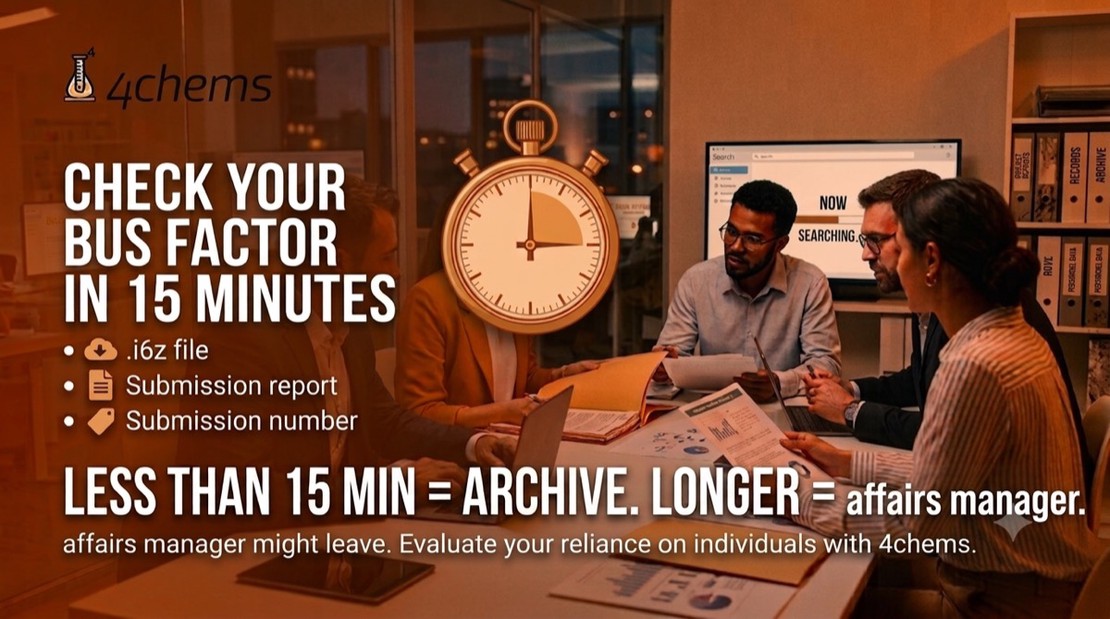
Does Your Compliance Team Need a Dossier Management System?
One of the questions regulatory affairs teams keep running into — usually right after something went wrong: do we need a …
Read More →Have questions? We're here to help.
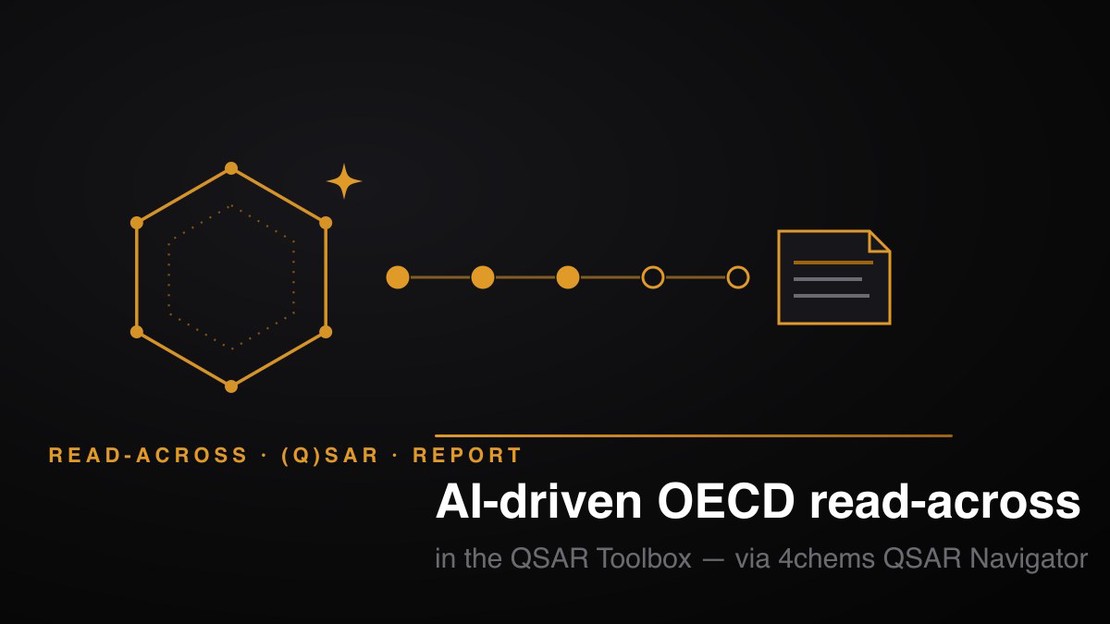
The QSAR Toolbox mirrors the OECD read-across workflow across eight stages. Here is how an AI assistant, connected through an MCP gateway, can drive that pipeline — from a SMILES string to a submission-ready QMRF, QPRF and CCR.
Have questions? We're here to help.
A defensible read-across is one of the most labour-intensive deliverables in regulatory toxicology. Done by hand, it means hunting databases substance by substance, copying values into a spreadsheet, arguing analogue similarity by eye, and hand-authoring the OECD reporting forms. The QSAR Toolbox already automates much of that science — and with an MCP gateway such as 4chems QSAR Navigator, an AI assistant can now drive the whole pipeline in your own regulatory language.
The Toolbox follows the OECD (Q)SAR and read-across workflow. Every assessment moves through the same stages, and each one maps to a step an assistant can take on your behalf:
You start with a structure. A SMILES string or CAS number becomes a validated Toolbox substance, with identity and composition checks that catch the CAS-to-structure mismatches which would otherwise invalidate a read-across before it began.
The agent searches the selected databases and drops the hits into a named working list — by CAS, name, SMILES, or a mechanistic SMARTS fragment that turns a hypothesis into a candidate category.
Profilers tag each list member with mechanistic and structural categories, and the Toolbox groups mechanism-grounded analogues around your target. The RAAF category-consistency checklist — physico-chemical, structural, mechanistic, ADME and data similarity — produces exactly the category-coherence evidence Annex XI demands.
A single call harvests experimental data for the whole category from the chosen databases. A per-database reliability battery — completeness, consistency, variation, qualifier distribution — gives you the quantitative backbone of a Klimisch-style reliability judgement.
Where it matters, the agent simulates metabolites and re-profiles them — revealing whether a benign parent yields an alerting metabolite.
This is the heart of it. The category becomes a live read-across, trend or (Q)SAR model: endpoint-versus-descriptor trends, residuals, cross-validated Q², an applicability-domain narrative, and a prediction committed to the matrix with full provenance.
The Toolbox emits the OECD deliverables, pre-populated from the assessment itself: the QMRF (the model passport), the QPRF (the per-substance prediction record), and the CCR (the category justification).
Whole assessments can be captured as reusable workflows, and ECHA IUCLID dossiers imported and exported directly — so the same defensible method runs identically every time.
The point is not that an AI “does the toxicology.” The point is that the defensibility evidence is generated alongside the prediction, not assembled afterwards. The RAAF assessment elements and the reliability battery are part of the pipeline, so when the assistant reports a prediction it already carries its category-consistency case, its applicability domain, and its cross-validated statistics. A request as simple as “build a skin-sensitisation category for this substance, fill the gap by read-across, and draft the QPRF” can drive all eight stages — with the toxicologist reviewing the reasoning at each step rather than performing the mechanics.
QSAR Navigator runs on top of managed QSAR Toolbox cloud hosting: always the current release, EU-hosted and GDPR-compliant. Every operation is authenticated against your own tenant. See 4chems QSAR Navigator for how it connects, or contact us for early access.
One of the questions regulatory affairs teams keep running into — usually right after something went wrong: do we need a …
Read More →
K-REACH. KKDİK. UK REACH. Four jurisdictions that looked at EU REACH and built their own version — each with its own …
Read More →
The question we get most often from compliance directors at consulting firms: how do you make sure my client’s …
Read More →