
·
6 min read
Does Your Compliance Team Need a Dossier Management System?
One of the questions regulatory affairs teams keep running into — usually right after something went wrong: do we need a …
Read More →Have questions? We're here to help.
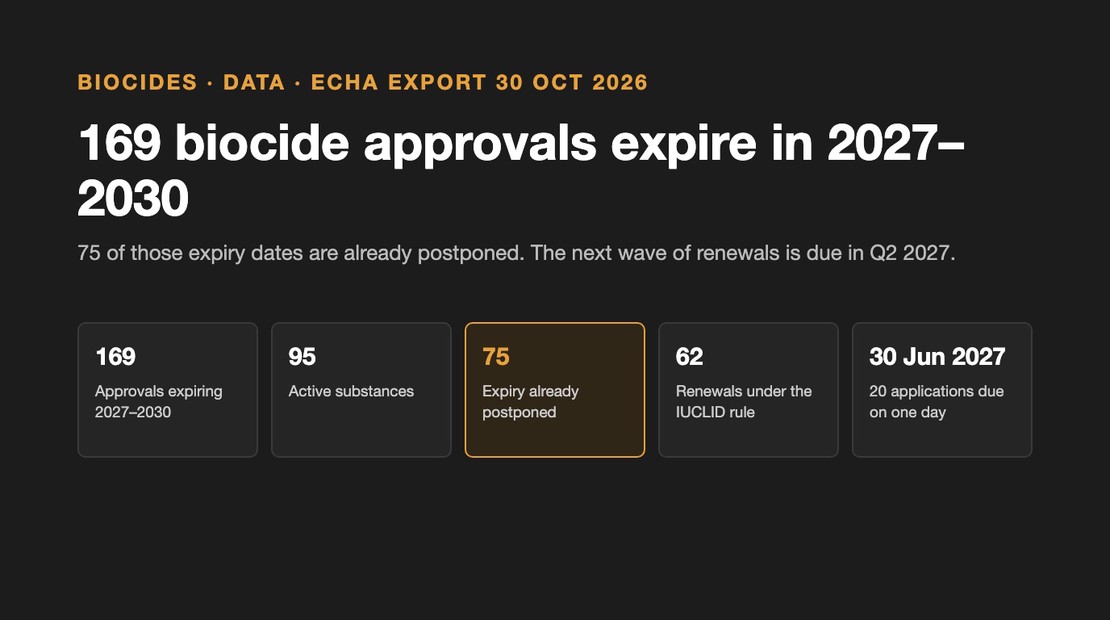
ECHA data, export of 30 October 2026: 169 biocidal active substance approvals expire in 2027–2030, 75 expiry dates are already postponed, and the next wave of renewals is due in Q2 2027.
Have questions? We're here to help.
In ECHA’s biocidal active substances database, 169 approvals of 95 active substances expire between 2027 and 2030 (export of 30 October 2026). For 75 of them, the expiry date comes from a Commission decision that postponed an earlier one. The other 94 still carry their original date, and for 62 of those the renewal application falls due on or after 1 July 2026, when all approval data has to be in IUCLID.
The number of approvals that expire each year, counted as active substance × product type.
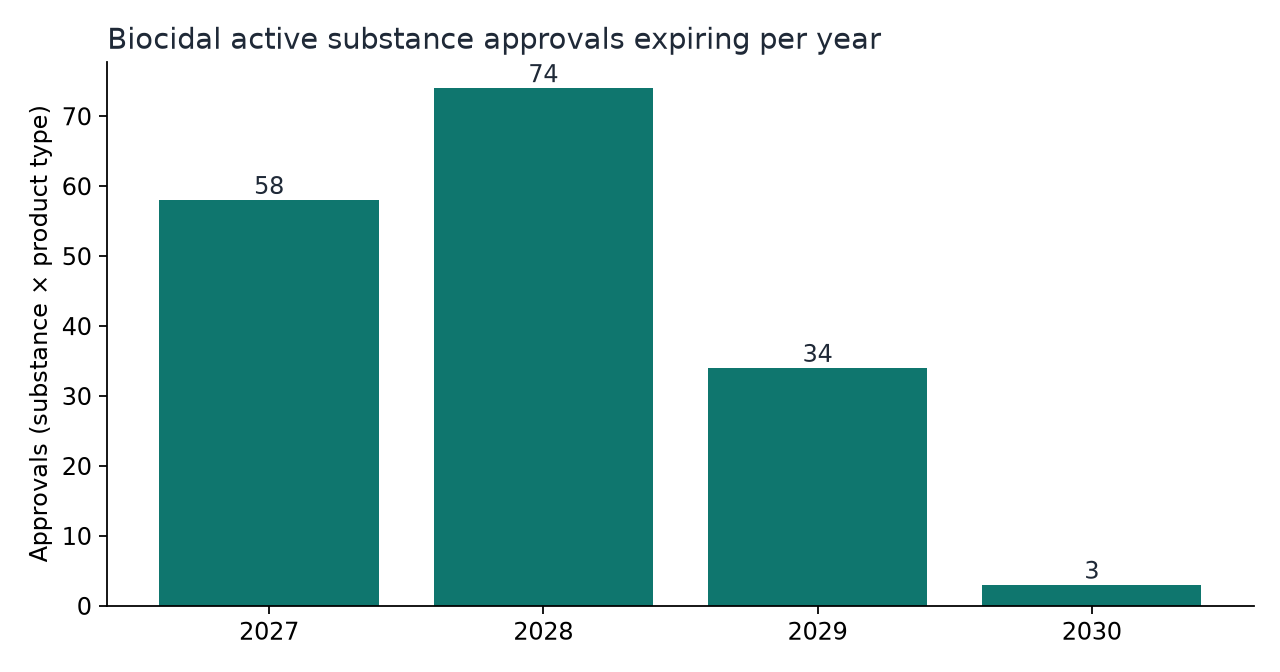
58 approvals expire in 2027, 74 in 2028, 34 in 2029 and 3 in 2030. Of these, the expiry date was already postponed for 26 in 2027, 26 in 2028 and 23 in 2029.
The dates are those recorded in the database on the export date. Postponements decided later are not included.
Approvals expiring in 2027–2030, by product type.
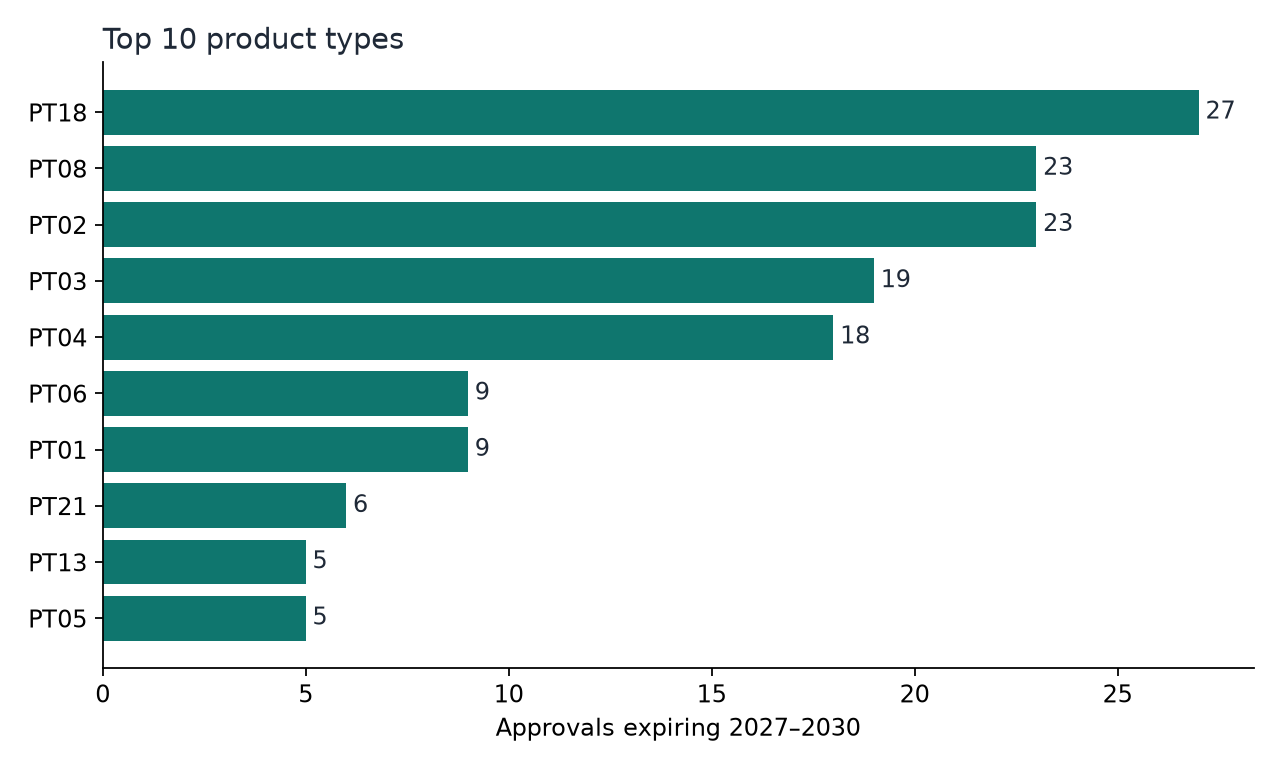
Insecticides and other arthropod control (PT18) lead with 27, followed by wood preservatives (PT08) and disinfectants not applied to humans or animals (PT02) with 23 each, veterinary hygiene (PT03) with 19 and food and feed area (PT04) with 18.
The count is of approvals, not of authorised products. One approval can stand behind many products.
When a renewal decision cannot be taken before an approval expires, the Commission postpones the expiry date. For 75 of the 169 approvals, the legal act recorded in the database is such a decision.
Three examples from the list:
The IPBC record shows no renewal in the database’s assessment status. That field does not list every pending renewal, so this article does not use it to say which approvals have been applied for.
Each approval’s latest date for a renewal application, 550 days before its recorded expiry, by quarter. For postponed approvals this date is shown for reference: their applications were due against the original expiry.
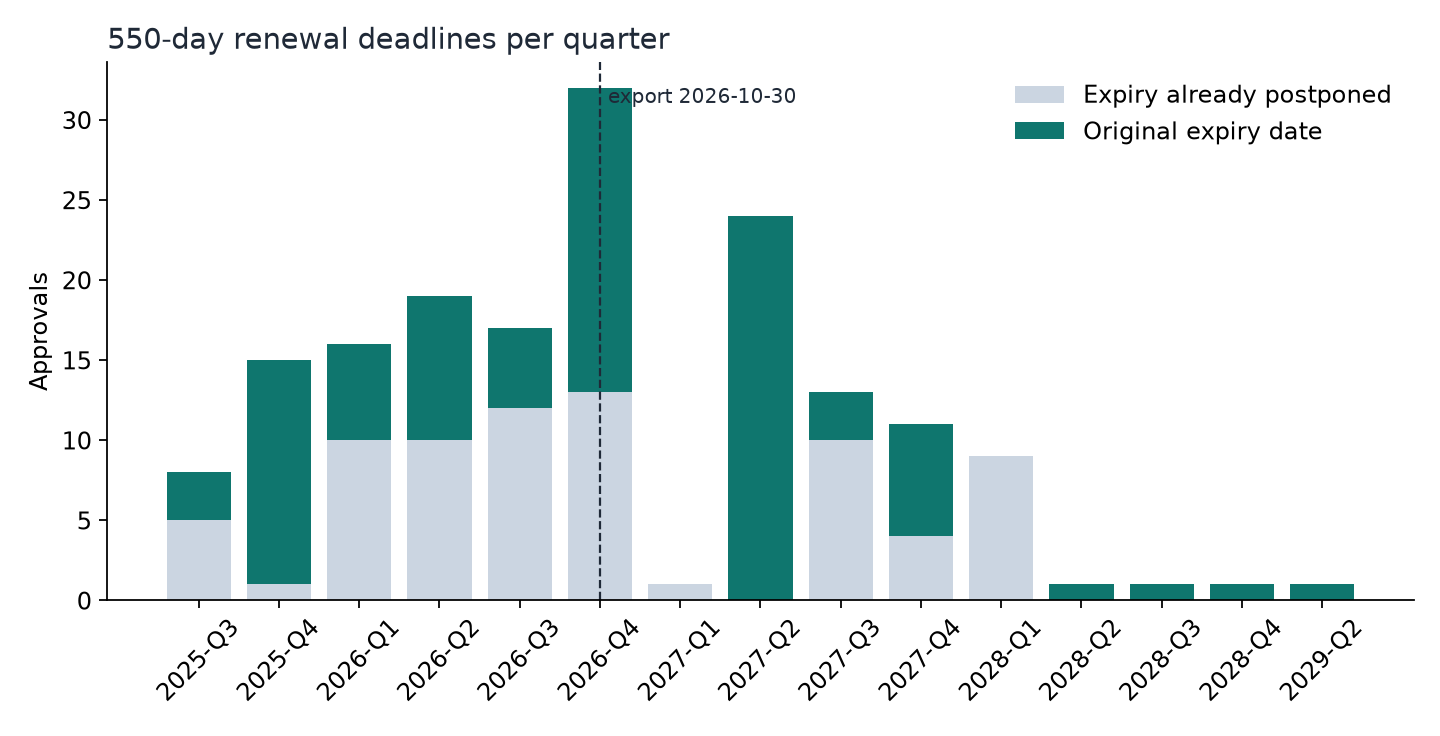
For the 94 approvals on their original date, the 550-day date has passed for 52, falls within the next 12 months for 37 and is later for 5. The largest group of upcoming dates is in the second quarter of 2027, with 24 renewal deadlines; 20 of them fall on one day, 30 June 2027, for approvals that expire on 31 December 2028.
Interpretation: a passed date does not mean that no application was made. The database does not show reliably which renewals have been filed.
Where a substance is approved for several product types, the application date follows the earliest expiry among them.
Since 1 July 2026, a renewal application must contain all approval data in IUCLID format, including the data from the original application. For 62 of the 94 approvals on their original date, the 550-day date falls on or after that day. Unless the application went in earlier, those renewals are prepared in IUCLID.
Postponement is common: 75 of the 169 expiry dates in 2027–2030 have already been moved. The evaluation of a renewal often takes longer than the time left on the approval.
For the approvals still on their original date, the next wave of renewal applications is due in the second quarter of 2027, built in IUCLID.
The data cannot show who is preparing an application, how far along it is, or which approvals will be left to lapse.
Preparing an active substance renewal in IUCLID? Talk to us about a hosted IUCLID. More on IUCLID for biocides.
This article is general information, not legal or regulatory advice.
One of the questions regulatory affairs teams keep running into — usually right after something went wrong: do we need a …
Read More →
The revised CLP Regulation (Classification, Labelling and Packaging) brings the biggest change to EU chemical hazard …
Read More →
Toxicology runs on some of the strictest lab standards in science: OECD guidelines, GLP protocols, validated assays. A …
Read More →The tools and solutions behind these insights — managed IUCLID, CHESAR and QSAR Toolbox in the EU cloud.