·
3 min read
Migrating Self-Hosted IUCLID to the Cloud: A Step-by-Step Guide
Running IUCLID on your own server made sense when you started. But on-premise installations quietly accumulate cost: …
Read More →Have questions? We're here to help.
A practical guide for regulatory affairs teams: when folder discipline is enough, when to invest in a system, and the 15-minute bus-factor test every team should run.
Have questions? We're here to help.
One of the questions regulatory affairs teams keep running into — usually right after something went wrong: do we need a dedicated system to manage our dossiers, or are we fine as we are?
Short answer: not always.
It depends on three things:
Some teams genuinely don’t need a system. Others needed one two resignations ago. This guide helps you figure out which team you are.
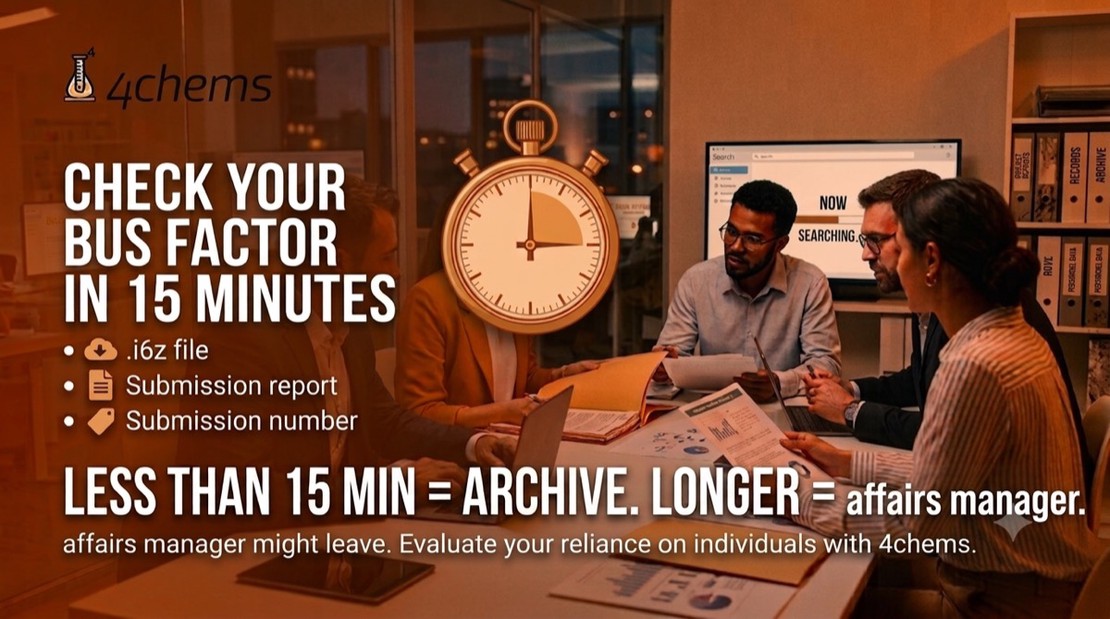
This takes 15 minutes and tells you more than any vendor demo.
Pick a dossier your team submitted three or more years ago. Now ask anyone on the team — except the person who filed it — to produce three things:
.i6z file that went to ECHA — not a working version, the submitted oneUnder 15 minutes? You’re in good shape. Skip to Step 2 to check whether growth will break what works today.
Longer than that — or the answer starts with “we’d have to ask Martina”? Then you don’t have an archive. You have Martina. And Martina is one job offer away from becoming your single point of failure in someone else’s org chart.
This isn’t hypothetical. The German chemical industry alone has lost more than 13,000 jobs since 2022 (VCI figures). And ECHA’s 2026 REACH and CLP report found that 54% of active registrations were not updated even once between 2021 and 2025 — one in six hasn’t been touched in over ten years, despite the legal obligation to keep dossiers current. Some of those frozen dossiers are frozen by choice. Others are frozen because nobody left in the building knows where they live.
You don’t need to buy anything. You need discipline. Here’s the minimum that works — five rules, total cost: zero.
The Minimum Viable Filing Framework
1. One canonical home per dossier. Your IUCLID instance is the master. Everything stored anywhere else — network drive, SharePoint, someone’s laptop — is a pointer to the master, never a competing copy. The moment two “current versions” exist, you no longer know which one is real.
2. Name by substance, never by people or projects. EC/CAS number + submission type + date. 200-001-8_ATP-update_2024-03 survives any reorganisation. Martina/Q3-projects/final_v2_NEW dies with Martina, or with Q3.
3. Freeze what was submitted. The exact .i6z that went out, the full submission report, and the submission number — stored together as an immutable snapshot, physically separated from working files. Working files change; the record of what the authority actually received must not.
4. Keep a register. One table: substance → dossier → location → last update → regulatory obligation → owner. A spreadsheet is fine. The rule that makes it work: if it’s not in the register, it doesn’t exist. No exceptions for “temporary” files.
5. Handover is a checklist against the register — not a conversation. A departing specialist walks the register line by line with their successor and signs it off. Conversations transfer impressions. Registers transfer archives.
If you run these five rules consistently, you have solved the continuity problem for a small portfolio. Genuinely — stop reading here if that’s you, and put the 15-minute test in your quarterly routine instead.
Folder discipline doesn’t scale linearly — it decays. Every new team member interprets the convention slightly differently. Every new jurisdiction (UK REACH, K-REACH, TSCA) brings its own formats, deadlines and update duties. Every acquisition brings someone else’s dossiers filed under someone else’s logic, usually undocumented.
At roughly 20+ substances or two+ jurisdictions, the register stops being a spreadsheet someone maintains and becomes a job nobody has. That’s the point where structure needs to live in a system rather than in habits.
Even if today works, check the trajectory:
If two of these three are on your horizon, treat Step 2’s “large portfolio” advice as already applying to you.
Honest comparison — including the options where you don’t buy anything.
1. Folder discipline + register Pros: free, immediate, fully under your control. Cons: depends entirely on people maintaining it — it’s exactly the thing that walks out the door. Best for: small, stable teams with one jurisdiction.
2. Generic DMS (SharePoint and friends)
Pros: versioning, permissions, search; IT probably already runs one.
Cons: it doesn’t know what a dossier is. No link between the IUCLID record, the submitted .i6z and the regulatory obligation — you’re rebuilding that logic in folder names again.
Best for: teams whose main gap is version control, not regulatory structure.
3. Regulatory-specific dossier management Pros: the system understands substances, dossiers, submissions and deadlines as first-class objects; the register maintains itself. Cons: cost, and a real migration effort — your archive has to be cleaned to be imported. (Full disclosure: this is the category 4chems builds in.) Best for: growing portfolios, multiple jurisdictions, teams that have already felt a failed retrieval.
4. Managed service Pros: fastest route — someone else builds and runs the structure. Cons: choose carefully: a provider that leaves you the register and the archive if you part ways is infrastructure; one that doesn’t is a new bus factor with a logo. Best for: teams with no capacity to run the migration themselves.
Three signals. Any single one is enough:
Teams that wait for the second signal pay for the first one twice.
You don’t need a system to avoid losing dossiers. You need to never have a “where is it?” moment. A system is just the cheapest way to guarantee that.
Whichever route you take — five free rules, a generic DMS, or software built for regulatory work — take it before the next resignation letter, not after.
Oliver Philippsen is the founder and managing director of 4chems. He writes about regulatory data management, dossier continuity, and the unglamorous infrastructure behind chemical compliance. If your team just failed the 15-minute test — he’d like to hear how long it actually took.
Running IUCLID on your own server made sense when you started. But on-premise installations quietly accumulate cost: …
Read More →
The EU Battery Regulation (Regulation (EU) 2023/1542, implemented in Germany by the BattDG, the national battery act) is …
Read More →
The revised CLP Regulation (Classification, Labelling and Packaging) brings the biggest change to EU chemical hazard …
Read More →