
·
6 min read
Does Your Compliance Team Need a Dossier Management System?
One of the questions regulatory affairs teams keep running into — usually right after something went wrong: do we need a …
Read More →Have questions? We're here to help.
Notification of intention first, application within 12 months, from 4 January 2027, no ECHA fee. The steps in IUCLID and where the time goes.
Have questions? We're here to help.
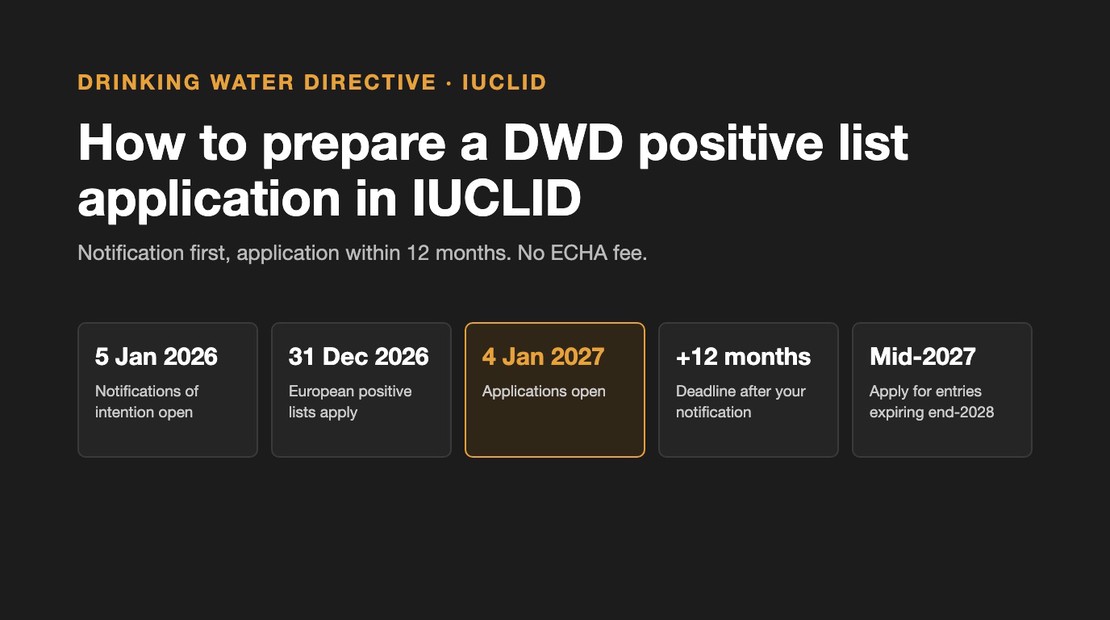
To add, amend or remove a substance on the European positive lists under the Drinking Water Directive (DWD), you submit a notification of intention to ECHA, then, within 12 months, a full application. Both are IUCLID dossiers. Notifications have been open on the ECHA Industry Portal since 5 January 2026, and applications can be submitted from 4 January 2027. ECHA charges no fee for either. The cost sits in the data: identity, composition, migration and toxicology, entered into IUCLID section by section.
| Date | What happens |
|---|---|
| 5 January 2026 | Notifications of intention open on the ECHA Industry Portal |
| 31 December 2026 | Four European positive lists apply, with 2,042 entries, and replace national lists |
| 4 January 2027 | Applications to add, amend or remove entries open |
| 12 months after your notification | Deadline for your application |
| At least 18 months before an entry expires | ECHA’s recommended latest start for an application to keep it |
Some entries on the lists expire on 31 December 2028. Counting back 18 months, applications for those entries should go in by mid-2027. ECHA processes applications first come, first served, and expects many of them.
The applicant is usually the company that puts the substance or material on the market: a maker of pipes, fittings, seals, coatings, cement or enamel, or its substance supplier. A consultant, an industry association or a consortium may also act as notifier and applicant for a group of companies. Each substance is notified on its own; mixtures cannot be notified, and only one notification per entry can be active at a time.
If your company already registers under REACH, the same ECHA account works on the Industry Portal once you add the Industry Portal Manager role.
1. Decide what you are asking for. Adding a new entry, amending an existing one (for example its conditions of use) or removing one. Check the four lists for organic, metallic, cementitious and enamel or ceramic materials before you start.
2. Submit the notification of intention. In IUCLID, create a substance dataset, choose the DWD notification working context, fill in identity, composition and intended use, validate, and export the dossier. Upload it on the Industry Portal. Your notification then appears on ECHA CHEM with your company name, so others with the same substance can find you.
3. Collect the application data. The Annex to Delegated Regulation (EU) 2024/369 lists what an application needs: substance identity, use and migration data, a toxicological dossier, and a risk assessment under the harmonised methodology of Implementing Decision (EU) 2024/365. Toxicological requirements are tiered by migration level. Read-across is allowed under the same rules as REACH Annex XI 1.5 and ECHA’s Read-Across Assessment Framework.
4. Build the application dossier in IUCLID. Switch the dataset to the DWD application working context and complete each section. If the substance is already registered under REACH, its robust study summaries can be reused: change the working context on the same dataset or use “Copy data from”. Data access rights still apply.
5. Validate and preview. Run the IUCLID validation assistant, fix what fails, and open the dissemination preview to see exactly what ECHA will publish.
6. Submit within 12 months of the notification.
The composition section. Every constituent and every impurity of an alloy or cementitious material is its own row, with a reference substance, a concentration range and remarks. In ECHA’s own tutorial, an expert with the reference substances prepared in advance needs about 35 minutes for a notification on one alloy. That is the smaller of the two dossiers, built by someone who knows IUCLID.
For a company that has never used IUCLID, add installation, user rights, learning the working contexts and creating each reference substance by hand.
Data entry does not have to be manual. IUCLID has a REST API. We built the same alloy notification from ECHA’s tutorial by script on a local IUCLID 10.0.3 in 2.4 seconds, with all 16 validation rules passing. That is one measurement on one setup, and it does not replace the work of collecting migration and toxicology data. It does remove the row-by-row typing.
The DWD rules say nothing about how an application is built, only what information it must contain and that data access rights are respected. Scripts and AI-assisted drafting are allowed, as long as a person checks the result.
At the October 2026 stakeholder workshop in Helsinki, ECHA stressed that applicants need an up-to-date IUCLID. An outdated installation can fail the latest validation rules or produce a dossier format ECHA no longer accepts. For a pipe or valve maker without regulatory IT, that is the step most likely to go wrong in January.
Is there a fee for a DWD application? No. ECHA charges no fee for the notification of intention or the application, whatever the size of the company.
Can I apply without a notification of intention? No. The notification comes before the application, and you have 12 months from it to apply.
Can a consultant or trade association apply for us? Yes. A consultant, association or consortium may act as notifier and applicant on behalf of a group of companies.
Can we reuse our REACH data? Yes, for study summaries you have rights to. Switch the working context on the existing dataset or copy the data across.
Can we notify a mixture? No. Each substance is notified individually.
When should we apply to keep an entry that expires in 2028? ECHA recommends applying at least 18 months before an entry expires, so by mid-2027 for entries expiring on 31 December 2028.
We host IUCLID; we do not prepare applications. Each client gets a dedicated instance, updated within 48 hours of every ECHA release. Consultants and associations applying for several companies can keep each member’s data in a separate instance. And where composition tables are long, data can go in through the REST API instead of by hand.
Preparing a DWD application and starting from zero on IUCLID? Talk to us about a hosted instance with the DWD working context ready.
One of the questions regulatory affairs teams keep running into — usually right after something went wrong: do we need a …
Read More →
Short answer: REACH has no registration deadline for companies in 2027. The last registration deadline was 31 May 2018. …
Read More →
Toxicology runs on some of the strictest lab standards in science: OECD guidelines, GLP protocols, validated assays. A …
Read More →