
·
3 min read
CLP 2026: New Hazard Classes and What They Mean for Your IUCLID Dossiers
The revised CLP Regulation (Classification, Labelling and Packaging) brings the biggest change to EU chemical hazard …
Read More →Have questions? We're here to help.
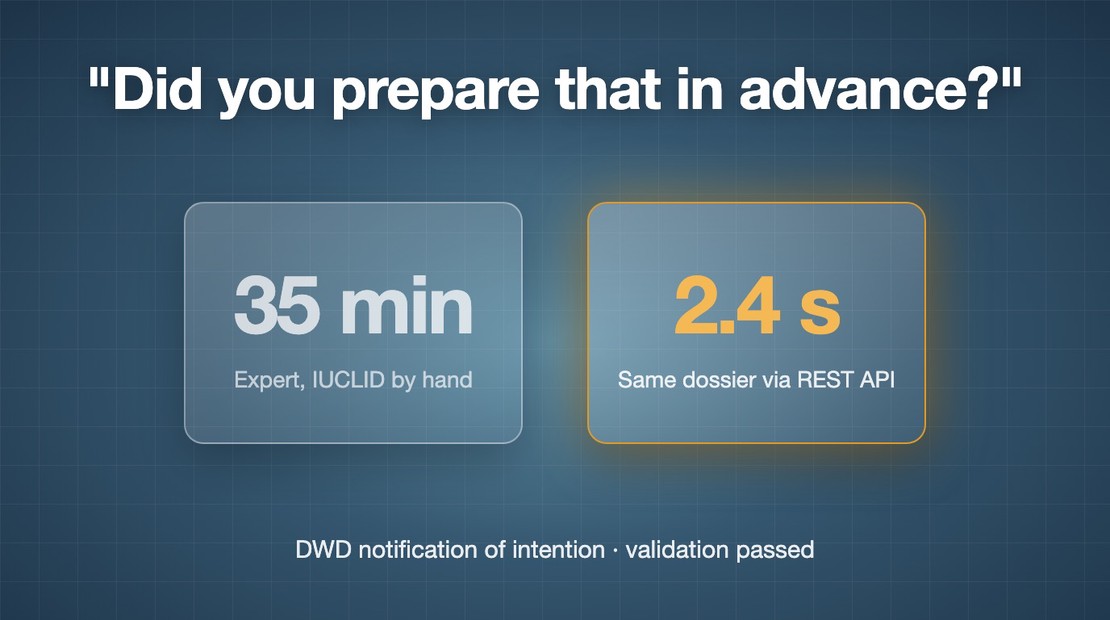
An expert needs about 35 minutes for a DWD notification in IUCLID; our API run took 2.4 seconds. Why that still loses price-scored tenders, and what we changed.
Have questions? We're here to help.
In almost every demo, someone asks the same question: “Did you prepare that in advance?”
We didn’t. It runs that fast.
ECHA’s own video tutorial on the Drinking Water Directive shows an expert building a notification of intention in IUCLID: one alloy, two composition documents, intended use, validation, dossier and export. It takes about 35 minutes on camera, and the expert has the reference substances prepared beforehand. We built the same dossier through the IUCLID REST API in 2.4 seconds, and it passed ECHA’s validation rules for that dossier type (16 rules, no failures).
That is one measurement on one setup, a local IUCLID 10.0.3 in September 2026, and we say so when we show it. But the gap is large enough that the setup details don’t change the conclusion.
The explanations come quickly. “It’s cached.” “It’s a pre-staged setup.” “Our internal data is much messier than yours.”
They are reasonable doubts. Regulatory teams have seen a lot of polished demos, and most IUCLID work they know is manual: one composition row at a time, one reference substance at a time, then a validation report that sends them back to fix two fields. When a whole dossier appears in the time it takes to click “export”, a trick is the more plausible explanation.
That is why we offer a trial on the customer’s own data. A demo on our example proves the software works. A run on their dossiers proves it works for them.
The people in the demo usually believe it by the end. A procurement scoring sheet is harder to convince.
Recently we scored 100% on the technical evaluation of a large chemical-industry tender for managed IUCLID hosting. The team liked what they saw. Half of the score was price, though, and our recurring fee was about twice the winner’s.
Here is roughly how that plays out in a 50/50 grid. Many tenders score price relative to the lowest bid, so a bid at twice the lowest price gets half the price points. We don’t know the exact formula this buyer used, so treat the numbers as an illustration:
| Technical (max 50) | Price (max 50) | Total | |
|---|---|---|---|
| Us, full technical marks, 2× price | 50 | 25 | 75 |
| Cheapest bid, just over half the technical points | 26 | 50 | 76 |
A perfect technical score cannot close a 2× price gap. The sheet had no column for “hours returned to the regulatory team”, so those hours counted for nothing.
We are learning to fill in that column ourselves.
None of this makes us cheaper. It makes the difference visible in the place where the decision is taken.
Below is the kind of table we are starting to attach to our offers. The left column uses ECHA’s own tutorial as the manual baseline. The volume row is a real customer’s figure; hourly cost, migration and validation results are added per customer after a trial on their data.
| Line item | Manual baseline | Through the API | Source |
|---|---|---|---|
| One DWD notification of intention (one alloy, two composition documents) | about 35 minutes, expert with reference substances prepared | 2.4 seconds | ECHA tutorial (Nov 2025); our run on IUCLID 10.0.3 (Sep 2026) |
| Dossiers prepared per year (one customer) | 1,288 | same | customer |
| Time from an ECHA IUCLID release to an updated instance | 2–12 weeks when self-hosted | within 48 hours | our project experience; our service commitment |
A rough example of the arithmetic: a team preparing 100 notifications a year at the expert’s pace spends about 58 hours building them by hand, before any corrections. A first-time applicant, who is slower on every composition row, spends considerably more. Multiply by the hourly cost, and the figure can sit on the price sheet next to our fee.
What follows is our reading of the market, not a forecast we can prove.
European chemical companies are under cost pressure, and consolidation and restructuring are back on the agenda. Regulatory IT sits in that budget. We see three ways it could go, and they are not exclusive.
Price grids get stricter. Procurement treats IUCLID hosting as infrastructure, like any other managed server, and the cheapest compliant bid wins. In that world the only question is whether a vendor clears the technical bar. Speed is a nice-to-have.
Integration work creates new demand. Mergers and reorganisations don’t merge regulatory data by themselves. Registrations move between legal entities, two IUCLID databases with different conventions have to become one, and duplicate registrations for the same substance have to be resolved. In that world, how fast and how safely data can be moved and rebuilt matters more than the monthly fee.
Buyers start scoring outcomes. If enough vendors put measurable numbers into their offers (hours per dossier, validation errors caught before submission, time from an ECHA release to an updated instance), tenders can start weighting them. That only happens if vendors supply numbers a buyer can check.
Our bet is on the third, and the way to get there is to publish numbers with their setup and let people rerun them on their own data. Which is why we answer the “did you prepare that in advance?” question with an offer to try it.
Want to see how your own dossiers behave through the API? Book a trial on your data. We host IUCLID in the EU with the REST API enabled; see IUCLID hosting.
The revised CLP Regulation (Classification, Labelling and Packaging) brings the biggest change to EU chemical hazard …
Read More →
Toxicology runs on some of the strictest lab standards in science: OECD guidelines, GLP protocols, validated assays. A …
Read More →
The question we get most often from compliance directors at consulting firms: how do you make sure my client’s …
Read More →