·
4 min read
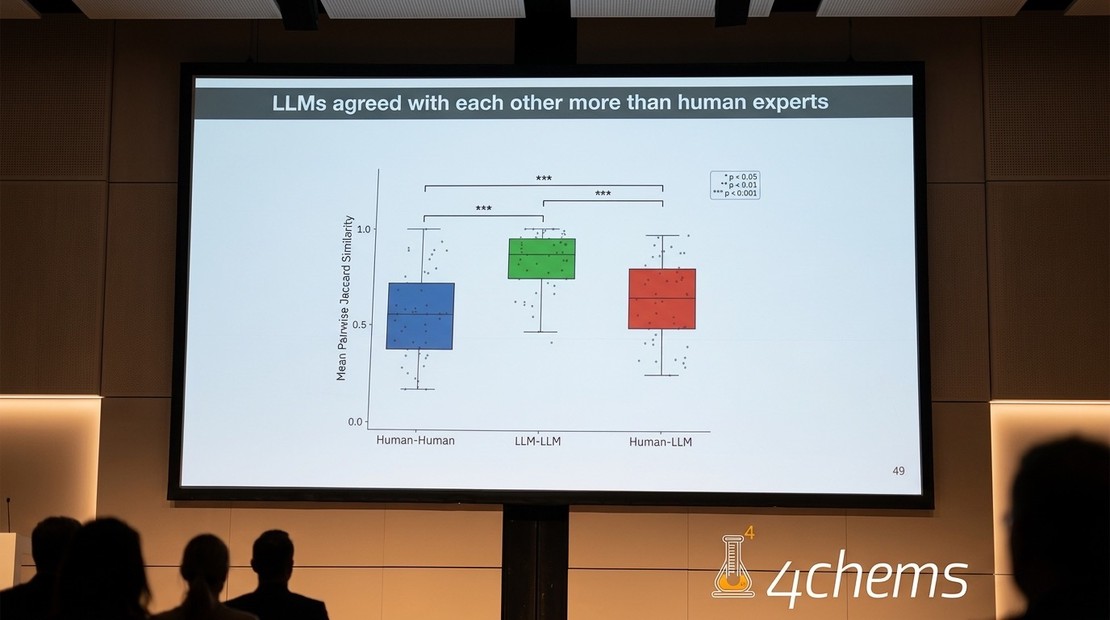
AI Models Agree With Each Other More Than Toxicology Experts Do
Toxicology runs on some of the strictest lab standards in science: OECD guidelines, GLP protocols, validated assays. A …
Read More →Have questions? We're here to help.
There is no REACH registration deadline in 2027. There is ECHA's 2027 screening target and five real dates before it. A step-by-step roadmap.
Have questions? We're here to help.
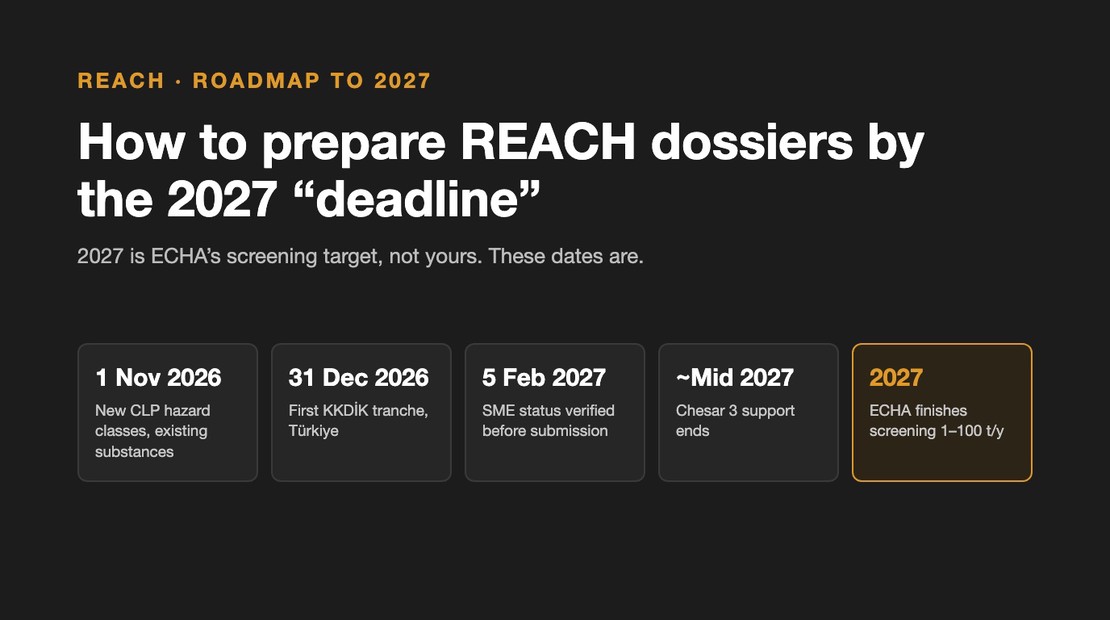
Short answer: REACH has no registration deadline for companies in 2027. The last registration deadline was 31 May 2018. 2027 is ECHA’s own target: by then it plans to have screened every registration in the 1–100 tonnes-per-year band. To prepare, bring existing dossiers up to date before ECHA reaches them, and plan for five real dates between now and mid-2027: 1 November 2026 (CLP), 31 December 2026 (Türkiye KKDİK), the IUCLID 6 v10 format, 5 February 2027 (SME verification) and the end of Chesar 3 support around mid-2027.
In 2019 the European Commission and ECHA committed to screening all REACH registrations: those above 100 t/y by 2023, and those in the 1–100 t/y band by 2027. Screening decides which dossiers go on to a compliance check, and a compliance check ends with a decision that tells the registrant what data to add and by when.
So the 2027 date belongs to ECHA, while the work it generates lands on registrants and their consultants. ECHA’s five-year report on REACH and CLP, published in June 2026, shows where the effort has moved: in 2021–2025 it received 18,911 initial registrations and 45,189 dossier updates. The registration phase is over. Most of the work now goes into keeping existing dossiers current.
There is also a widespread assumption that “REACH 2.0” will change the rules before 2027. It will not. The Commission’s impact assessment received a negative opinion from the Regulatory Scrutiny Board in autumn 2025, and the comprehensive revision has since been put on hold in favour of narrower simplification measures. Plan against the current regulation.
| Date | What happens | Who it affects |
|---|---|---|
| Since 5 Nov 2025 | Standard REACH fees up 19.5% (Implementing Regulation (EU) 2025/2067); SME fees unchanged | Large companies registering or updating |
| Since 27 Apr 2026 | IUCLID 6 v10 with a new data format (current patch: 10.0.3) | Everyone preparing a dossier |
| Since 2 Jun 2026 | ECHA’s new Chesar Platform available; Chesar 3 supported for about one more year | Registrants that need a chemical safety report |
| 1 Nov 2026 | New CLP hazard classes (Delegated Regulation (EU) 2023/707) apply to substances already on the market | Substance suppliers in the EU |
| 31 Dec 2026 | First KKDİK registration deadline in Türkiye | ≥1,000 t/y; aquatic hazard ≥100 t/y; CMR ≥1 t/y |
| 5 Feb 2027 | ECHA verifies SME status before submission instead of afterwards | SME registrants |
| ~Mid-2027 | End of support for Chesar 3 | Anyone still writing CSRs in Chesar 3 |
| 2027 | ECHA completes screening of the 1–100 t/y band | Registrants in that band |
List every registration you or your clients hold, with tonnage band, last update date and the IUCLID version it was last edited in. Dossiers in the 1–100 t/y band that have not been touched since 2018 are the ones ECHA’s screening will reach first. Typical triggers for an update that was never made: a tonnage band change, a new use, new hazard information, a harmonised classification adopted after registration.
The six hazard classes added by Delegated Regulation (EU) 2023/707 (ED HH, ED ENV, PBT, vPvB, PMT, vPvM) apply to substances that were already on the market from 1 November 2026. Where a new class applies, the classification in the IUCLID dossier and the C&L notification must change with it. Do this before the general update wave, because the classification feeds the rest of the dossier. Details: CLP 2026: New Hazard Classes.
Version 10.0.0, released on 27 April 2026, introduced a new format. Before a wave of updates, make sure every IUCLID instance, script and integration that reads or writes your dossiers is on v10. For consultants that includes clients who keep their own installations and send you exports. A dossier that passes validation in an older version is not proof that it will pass in the current one.
If your clients export to Türkiye, the first KKDİK deadline covers substances at 1,000 t/y or more, substances classified Aquatic Acute 1 or Aquatic Chronic 1 at 100 t/y or more, and CMR category 1A/1B substances at 1 t/y or more. The next deadlines are 31 December 2028 (100–1,000 t/y) and 31 December 2030 (1–100 t/y). KKDİK uses IUCLID 6 files, which makes legacy IUCLID 5 data a recurring problem: Your IUCLID 5 file won’t go into KKS.
Under the same Implementing Regulation (EU) 2025/2067, ECHA moves from checking SME status after a submission to verifying it before. From 5 February 2027, an SME has to request verification at least two months before the submission it is planning. ECHA has two months to decide, and the confirmed status is valid for three years. For an SME client with an update planned in spring 2027, the request belongs in this year’s plan.
ECHA launched the first version of the Chesar Platform on 2 June 2026. It combines Chesar and EUSES and runs in ECHA Cloud Services. Chesar 3 remains supported for about one more year. The first version covers “simple” substances, assessed from a single set of substance properties; multi-constituent and UVCB substances may need to stay in Chesar 3 for now. Check ECHA’s current guidance on which tool to use for official submissions, then pilot one CSR on the Platform before support for Chesar 3 ends.
Standard REACH fees rose by 19.5% from 5 November 2025, reflecting cumulative inflation for 2021–2023. SME fees were not indexed. For a large company planning a tonnage band update or several dossier updates in 2027, the increase belongs in this year’s budget.
For a consultancy with 10 or 15 clients, the slow part is rarely typing data into IUCLID. Three steps repeat for every dossier and every client:
This is the part 4chems is built for. Our EU-hosted environment runs IUCLID, CHESAR, the IIP and the QSAR Toolbox side by side and is updated within days of each ECHA release, which matters in a year with a new IUCLID format and a new Chesar. The IUCLID AI Observer checks a dossier for cross-section errors that the Validation Assistant does not report. A consistency review that takes about four hours by hand takes under ten minutes. A human expert decides every change. System-to-system submission to REACH-IT replaces the manual upload step.
No. The last REACH registration deadline was 31 May 2018. 2027 is the year by which ECHA aims to have screened all registrations in the 1–100 t/y band. Registrants must keep dossiers up to date at all times, not only before a deadline.
Not on current information. The comprehensive revision was put on hold after the Regulatory Scrutiny Board’s negative opinion in 2025. Plan against the regulation as it stands, plus the dates in the table above.
Start with dossiers where something has changed since the last update: a new harmonised classification, a new CLP hazard class under 2023/707, a different tonnage band or new uses. Then update dossiers in the 1–100 t/y band that have not been touched since 2018.
Standard REACH fees increased by 19.5% from 5 November 2025 under Implementing Regulation (EU) 2025/2067. Fees for SMEs were not increased.
Yes, for about one more year after the Chesar Platform launch on 2 June 2026. Check ECHA’s guidance on which tool to use for official submissions, and test the Platform on your substances before support for Chesar 3 ends.
Planning dossier updates for several clients before 2027? Talk to an expert and we will map the dates to your portfolio.
Toxicology runs on some of the strictest lab standards in science: OECD guidelines, GLP protocols, validated assays. A …
Read More →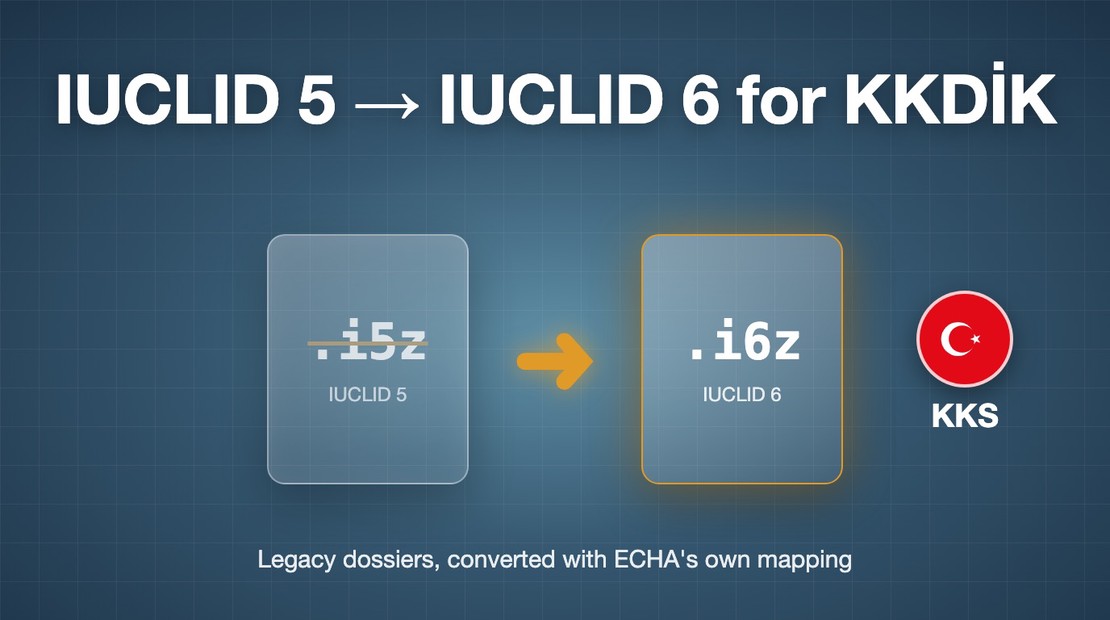
On 31 July a Hungarian manufacturer sent us two files ending in .i5z with one short question: can Türkiye accept these?
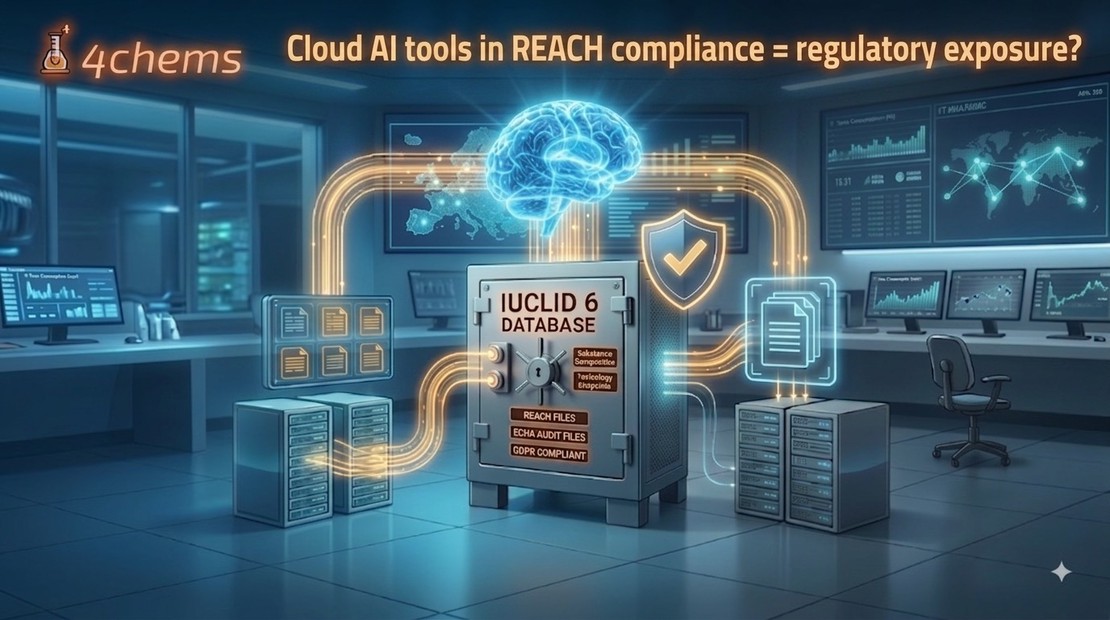
The debate around cloud and AI tools in REACH compliance usually revolves around one word: risk.
Read More →